Sleeping in a cold home during a winter power outage
SleepKey points
- Cold causes more deaths than heat, especially from heart and lung disease.
- The best sleep insulation: layers, a hat, socks and a sleeping bag or several blankets.
- Choose the smallest room and sleep together to keep warm.
- A generator, gas stove, grill or camp stove indoors is a deadly carbon monoxide risk.
- Fill hot water bottles with hot, not boiling, water and wrap them in cloth.
Why cold is dangerous
An analysis of more than 74 million deaths in 13 countries, including the U.S., found that cold is linked to far more deaths than heat. Cold narrows blood vessels, raises blood pressure and thickens the blood, increasing the risk of heart attack, stroke and lung disease flare-ups (Gasparrini et al., 2015). Older adults, people with chronic illness and infants are most vulnerable. Winter storms that knock out power, like the 2021 Texas outage, show how quickly homes become dangerously cold.
Cold also disrupts sleep: when you are cold you wake more often and your heart works harder (Okamoto-Mizuno & Mizuno, 2012).
How to prepare your sleeping area
- Choose one small room and gather the household there. Close doors to other rooms.
- Insulate windows with heavy curtains, plastic film or a blanket at night.
- Insulate the bed from the floor with a camping pad or extra blanket under the sheet.
- Use a sleeping bag: it holds heat better than ordinary bedding.
How to dress
- several thin layers are better than one thick one;
- a hat and warm socks;
- dry clothes: change out of anything damp with sweat before bed;
- avoid tight clothing that restricts circulation.
How to warm up safely
- Hot water bottle: hot, not boiling, water, wrapped in a towel; never for infants.
- A warm drink before bed if you can heat one safely.
- Battery-powered or USB heated blankets are safer than an open flame.
The biggest danger: carbon monoxide
A review of disaster-related carbon monoxide poisoning found that the main causes were generators used indoors, in garages or basements, and devices not designed for heating, such as stoves and grills (Iqbal et al., 2012). Carbon monoxide has no smell.
Never use a generator, gas stove or oven, charcoal grill or camp stove inside your home for heat. Place generators outdoors, at least 20 feet from windows and doors. Install battery-powered carbon monoxide alarms.
Look out for others
Call older neighbors and relatives who live alone. Cold and darkness are most dangerous for those with no one to share warmth with and who cannot get to a warming center on their own.
Frequently asked questions
Is it safe to sleep with a propane or camp heater on?
No. Any fuel-burning device in a closed room while you sleep can cause carbon monoxide poisoning without waking you. Turn it off before sleep.
How do I keep a baby warm at night?
Dress the baby in several thin layers and use an age-appropriate wearable blanket or sleep sack. Never put pillows, loose blankets or hot water bottles in an infant’s sleep space.
Does alcohol help you warm up?
No. It makes you feel warm but widens blood vessels in the skin, so the body loses heat faster.
Sources
- Gasparrini et al. (2015). Mortality risk attributable to high and low ambient temperature: a multicountry observational study. The Lancet 386(9991):369-375. doi:10.1016/S0140-6736(14)62114-0
- Iqbal et al. (2012). A Review of Disaster-Related Carbon Monoxide Poisoning: Surveillance, Epidemiology, and Opportunities for Prevention. American Journal of Public Health 102(10):1957-1963. doi:10.2105/AJPH.2012.300674
- Okamoto-Mizuno et al. (2012). Effects of thermal environment on sleep and circadian rhythm. Journal of Physiological Anthropology 31(1). doi:10.1186/1880-6805-31-14
Keep reading
 Sleep
Sleeping in the heat: how to rest on hot nights
Why hot nights shorten sleep, who is affected most and what helps: ventilation, a cool shower, light bedding and fans.
 Sleep
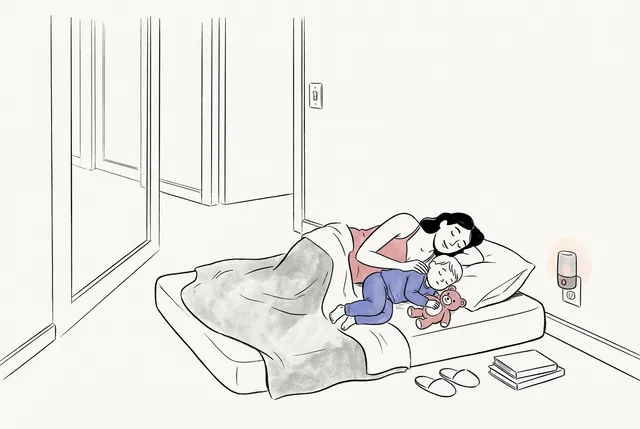
Helping children sleep after frightening events and emergencies
How to help a child sleep after a disaster, emergency or scary news, what to do about nightmares, why a bedtime routine matters and when to get professional help.
Sleep · Myth or factMyth or fact: mouth taping improves sleep
Does taping your mouth shut at night help snoring and sleep? What a systematic review found and who may be put at risk.
Related topics from other pillars
Cold weather and power outages: getting through winter together
Why older and isolated people are at greatest risk during winter storms and outages, how to plan with neighbors and family and what never to use for heat.
 Physical Activity
Extreme heat and health: how to avoid overheating
Who is most at risk during heat waves, the signs of heat stroke and what really cools you down: fans, water, shade and changing your schedule.
Sleep tools
How much sleep do you need? Recommendations by age
Recommendations from the American Academy of Sleep Medicine and the National Sleep Foundation.
QuizSocial jet lag calculator
The difference in your sleep midpoint between workdays and days off.
QuizWhen should you stop drinking coffee? Calculator
According to a meta-analysis, have a regular coffee at least about 8.8 hours before bed.
PDF · DiaryTwo-week sleep diary
Record bedtime, wake time, awakenings, caffeine, alcohol and how you feel.
PDF · TrackerMonthly 24-hour sleep tracker
A visual sleep rhythm tracker that shows your schedule and social jet lag.
PDF · ChecklistBedtime routine checklist
A step-by-step wind-down routine with a weekly tracker.